Condition

Beyond The .357 Magnum
Many revolver fans are familiar with the .38 Special, the .357 Magnum, and probably even the .44 Magnum. But today on the Dead Calibers Archive we’ll be talking about some of the strangest and obscure revolver calibers that have been created for the trusty six shooter.
Article Video
Table of Contents
Strange Revolver Calibers
Typically when we think of revolver cartridges we think of straight walled brass with a small rim for ejection. We can all picture the bandolier of an old west gunslinger filled with cartridges for his trusty six shooter.
But what if there were other cartridge designs that you may not have heard of for the classic wheel gun?
Designs that tried to push the envelope in what could be done with a revolver?
I’m Anders E.T. Herzberg and on today’s episode of the Dead Caliber’s Archives we’ll be talking about the history of some of the most unusual and strange revolver cartridges and why they faded into the background.
Setting the Stage
To go down this rabbit hole we should probably talk about a few things first.
For wheel gun aficionados and old hats in the gun game this will probably be old news but for anyone who’s not familiar, we should define a few terms.
Just about every revolver cartridge that you are likely to run across has either a straight or ever so slightly tapered wall to the side of the cartridge along with a rim around the base of the cartridge for the ejector to catch onto but today we’ll be talking about some of the exceptions to this, specifically bottled necked and similar cases.
A bottle necked case usually refers to a design that uses a smaller diameter bullet than the case. Large enough that a neck and shoulder is formed in the case to accommodate the smaller bullet.
.223 or 5.56 uses this design but it’s not referred to as a bottle necked cartridge often.
This design does three things. One for semi-auto’s it makes feeding easier, aiding the movement of the cartridge from the magazine into the chamber with a “ramp’ built into the cartridge. Two, it gives more velocity as all things being equal you get more pressure and powder behind a smaller bullet leading to, ideally, better accuracy and penetration. Finally, a bottle necked design can aid in extraction from the chamber reducing friction as the firearm cycles out the spent casing. Decreasing the friction after the first part of the extraction is completed as less of the case is contacting the chamber wall inside of the gun.
Now revolvers traditionally don’t need any of the advantages that I just listed. It’s a comparatively simple action that does not have the additional decades of development and refinement that inform modern cartridge design.
In a revolver nothing needs to be loaded or extracted from a magazine and chamber by an internal mechanism. Upping the pressures in the gun was just not practical for a variety of manufacturing reasons. So “big bullets” were the best way to achieve the desired result on target.
Of course this is an oversimplification, but the big takeaway is that revolvers were made for the more or less straight walled cases that were easier to produce at that time.
However, there were exceptions, some odd balls and some attempts to retrofit more “modern” advancements into the old wheel guns. So let’s dive into them.
First we need to take a trip to go see the great big Russian bear.
7.62 Nagant
The first revolver cartridge we’ll be talking about is the 7.62 Nagant.
Now this is not technically a bottle necked cartridge, but something a bit different.
Designed in 1894 by Léon Nagant for the Nagant M1895, the cartridge was unusual in that the brass was much longer than other cartridges of the era because unlike other cartridges the bullet was fully seated into the brass with none of the bullet exposed.
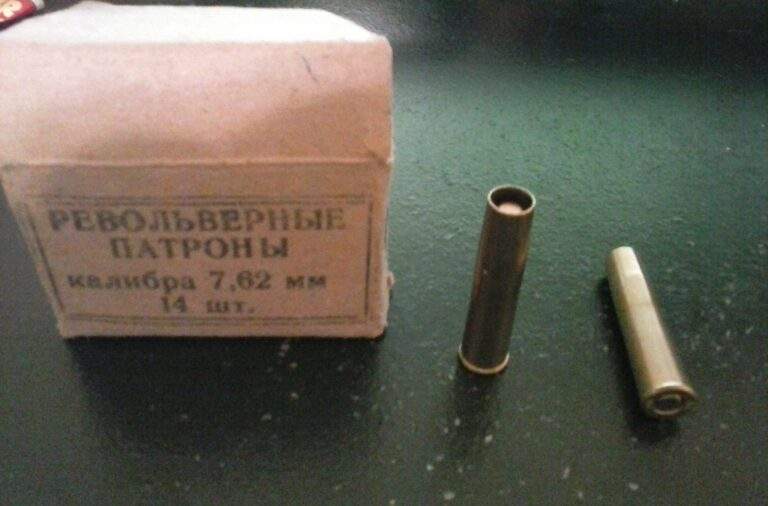
The brass would be crimped above the bullet, giving us a pseudo-bottlenecked design. Now you may think that this was to keep the bullet seated in the case, however the design had a different purpose.
Instead in the M1895 the revolver’s cylinder cammed forward moving the brass into the barrel just enough to create a seal to prevent the gasses from escaping out the side of the cylinder gap. This small change produced increase velocity over other revolver designs and it was safer as you can find many “hot dog” experiments with cylinder gaps on YouTube. While the velocity increase was negligible, reportedly around 50 to 150 feet per second it was a noticeable improvement.
Performance numbers available are all over the place, probably due to old stock being tested, manufacturing inconsistencies and more.
108 grains seems to be common for the original bullet weight but velocity numbers I have found range from 1,100 fps to 730. In modern production loadings things seem to have been toned down for aged revolvers and 97 and 98 grain loadings at 740 to 750 fps seems to be what’s floating around today.
The 7.62 Nagant cartridge was actually a second generation cartridge for the M1895 as the first version of Nagant’s gas seal revolver, before adoption by the Russian military, used the black powder 9.4x22mmR Nagant cartridge instead. Much the same design concept this cartridge was only different in its dimensions and use of black powder.
Yet the advantages to this revolver and cartridge design did not stop there. The gas seal also allowed for the practical use of suppressors and this was done occasionally. Though modern media has probably made this seem more common than it actually was.
However the M1895 was, at the time of adoption by the Russian military, a dated and slow to reload design, but this was offset by the ease of manufacture for the revolver.
The M1895 did remain in service until 1952 with the Russian military being slowly phased out by the Makarov and the Tokarev.
Of course being a Russian military revolver with such a long service life 2 million M1895’s were produced and far far more 7.62 Nagant ammo was produced.
Yet the 7.62 Nagant cartridge was just the beginning. Proper bottle necked revolver cartridges would eventually appear, though they would never be as successful as the 7.62 Nagant for a number of reasons.
.22 Remington Jet
Now we go back home to the US and in 1961 we find the .22 Remington Jet.
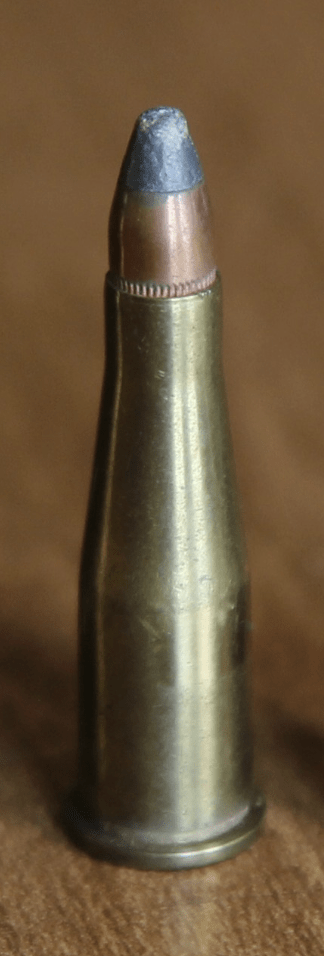
Strange looking by modern cartridge designs, the .22 Jet sticks out for it’s almost missel like design. Looking ready for takeoff just sitting on the table.
This was a joint venture by Remington and Smith & Wesson, I’ve sadly been unable to track down who at Remington and Smith & Wesson worked on the project as of this writing, but the cartridge was created to be a contender to other .22 caliber wildcat revolver cartridges that were being experimented with by gunsmiths and shooters.
The idea was to take a .357 Magnum case and neck it down to a .22 caliber bullet.
This gave the rather diminutive 40 grain bullets a pretty impressive 1,600 to 1,700 fp/s out of an eight and a half inch barrel. While I can’t find exact data for shorter, more practical barrels at the time of this dispatch I’d imagine we’d still be talking at least 1200 to 1300 fp/s in a more practical revolver barrel length. Though I have seen at least one source say that the .22 Jet could go up to 2,400 fp/s in a handgun.
While the Smith & Wesson Model 53 was the primary wheel gun for this cartridge, Thompson/Center did chamber the Contender in .22 Jet. The Contender was a simple single shot break action pistol but the Model 53, a variant of the Model 17, had the additional trick of being able to use chamber inserts to fire .22 Short, Long, and Long Rifle cartridges. Though these did not produce the greatest accuracy from the research I’ve done. Finally I should note that the Model 53 was produced from 1960 to 1974.
However, getting back to the subject proper, the .22 Jet and the Model 53 is where we start to see some of the issues with the bottlenecked case design in a revolver.
The .22 Jet rapidly got a reputation for being, finicky. Scattered reports seem to suggest that the case could set back while firing, locking up the cylinder and causing cycling issues.
Another complaint about the .22 Jet that I have seen is extraction issues. With the cylinder itself designed for the long neck of the cartridge it can expand and stick in the cylinder making getting it out a chore.
While this can happen with just about any case, a bottle necked design with what may have been questionable manufacturing from Smith & Wesson for the Model 53 could cause this issue. However, much of these reports come from decade old forum posts and one off accounts.
So because of these anecdotes, deserved or not, the .22 Jet got a bad reputation and it along with the wildcat craze it was chasing faded into history. But the .22 Jet was not the only bottlenecked revolver cartridge to appear on the scene.
.357/44 Bain & Davis
In 1964 Keith Davis, co-owner of Bain & Davis Gunshop in San Gabriel California wanted to improve upon the .357 Magnum. What he came up with was the .357/44 Bain & Davis cartridge.
While I can’t find much in terms of specs, the .357/44 Bain & Davis did pretty much what it said on the tin. Taking a .357 caliber bullet and necking down a .44 Magnum case to send the bullet screaming down range.
As far as I can find, it was comparable with the .357 Remington Maximum, basically the .357 Magnum wearing platform shoes.
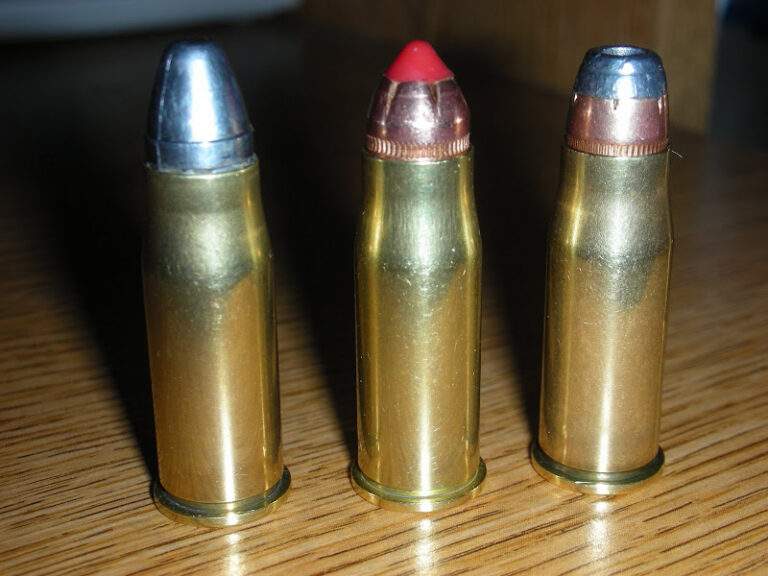
Getting back to the Bain & Davis. It would remain a bit of a unknown until the 1970’s when competition silhouette shooters starter taking up the round for use in matches and while a few S&W Model 27’s were apparently modified for the cartridge the Ruger Blackhawk would get a similar treatment more often.
I can’t find any confirmation if there were any formal production guns that used the .357/44 Bain & Davis but at the very least the B&D gun shop was converting pistols for at least a few years. One forum post does say that the Thompson/Center Contender was given a B&D flavor, but I can’t really confirm if this was a factory option or an aftermarket one as of this writing.
While the Bain & Davis did have a good following for some time, and still get’s the occasional question about it on forums, the issue of cartridge setback was still a problem, causing reliability issues.
Additionally the short case neck didn’t help it as loadings over 125 grains start to eat into the powder charge and the advantages that it gets over other options start falling off.
So the .357/44 Bain & Davis eventually fell into the memory hole too.
.357/44 Bobcat
Finally the last and probably the most well documented entry on our list today is the .357/44 Bobcat, but it is also the strangest.
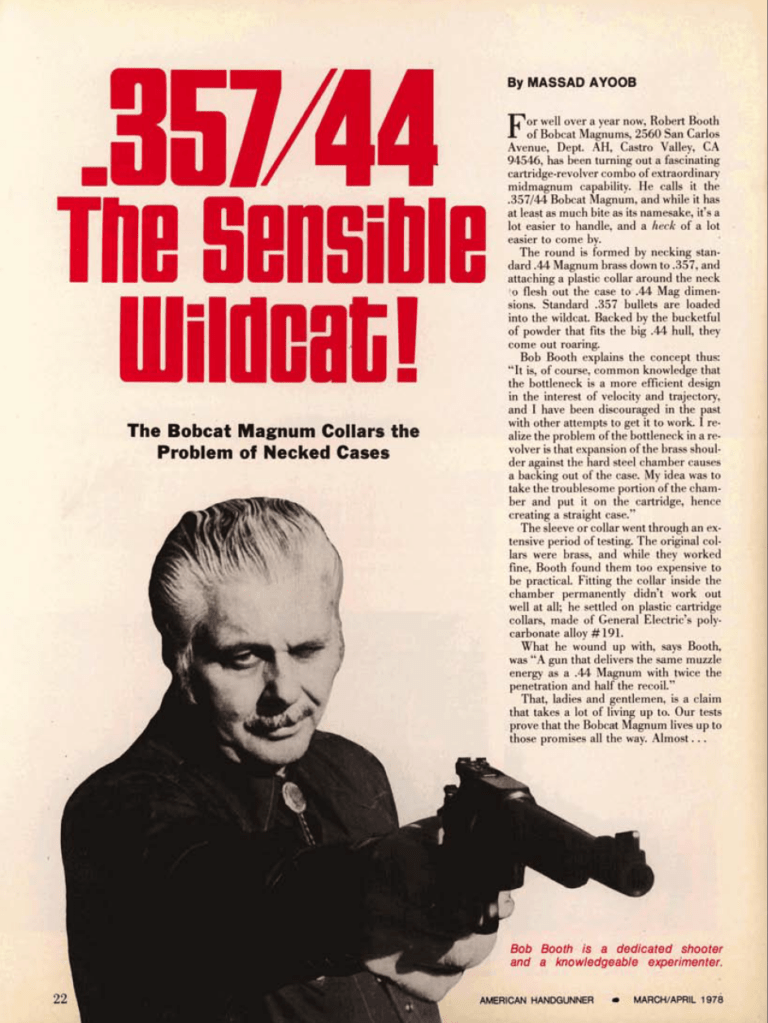
Created by Robert Booth of Bobcat Magnums sometime before March of 1978 it was much the same as the Bain & Davis but Booth had a trick up its sleeve to solve the problems that we have previously discussed.
A quick note on the dates. The entry in Cartridge Collector.Net states that the Bobcat was developed in the mid 80’s but Massad Ayoob wrote a full length article in American Handgunner for the March & April 1978 edition of the magazine. Something that I’ll be heavily relying on for this section. So development of the .357/44 Bobcat had to have started in earnest well before this date as there’s a fair amount of testing that is described in the article.
Now, for Booth the solution was to move the problem of the bottleneck away from the cylinder and to the cartridge.
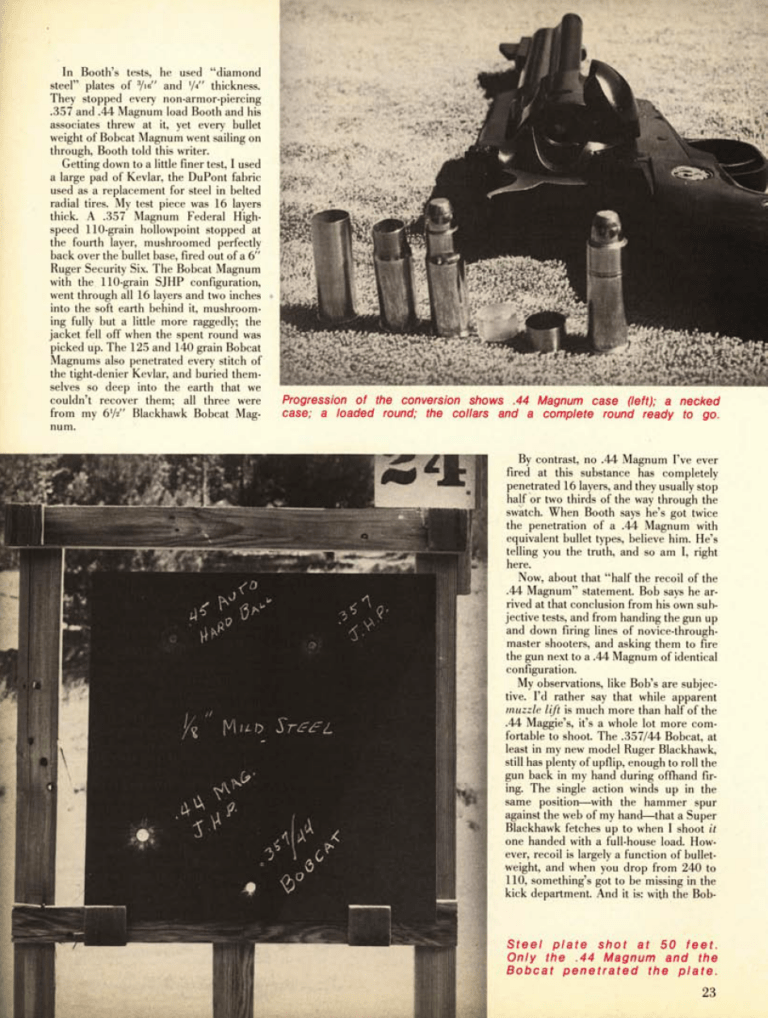
Instead of a cylinder chamber for a necked cartridge, something that all of these previous cartridges had needed, Booth did what the Bain & Davis iteration did not, and added a collar to the case to allow it to fit in a more or less standard .44 Magnum cylinder.
Booth went through a few different iterations of this collar idea. Brass designs as well as an iteration where the collar was part of the cylinder were tested but it seems the final version of the .357/44 Bobcat used GE’s polycarbonate alloy #191. So a plastic ring was added.
The ring was something of a disposable item, Booth himself reported that it was not able to get “his” loadings to keep the rings intact for more than two shots, though others with presumably lighter loads were able to get more life out of them.
For velocities I was able to find a test table with speeds ranging from 2,053 fp/s to 1,743 fp/s and bullet weights from 90 to 140 grains all using a 6 and a half inch barrel.
In the article from Ayoob you’ll see a picture of a round of .357/44 Bobcat having penetrated a 1/4 inch steel plate. Additionally the testing in the article reports a 125 grain and 140 grain rounds penetrating Kevlar body armor.
The market as a whole seems to have gotten on board with Booth, or at least the concept of the .357/44 for a time as RCBS was producing dies for a time for the .357/44 Bobcat, though to be fair .357/44 dies for the Bobcat or the B&D flavor would probably be much the same.
For pistols it seems no factory models were ever produced but Booth did or helped with conversions on Ruger Black Hawks, Smith & Wesson N fames such as the Model 27 or 28.
For users there was, according to Booth at least one police officer who carried a .357/44 Bobcat, requesting it from Booth directly after his .357 failed to get through a car door in a gun fight.
So formal adoption no, one crazy Sherrif, yes.
Booth, in his interview with Ayoob did note that he was working on other, similar projects. A .357/44 Special for the Charter Arms Bulldog, a .22/357 version, and a .357/45 Long Colt. Though I’m not sure how far any of these projects got.
If I had to guess the more complicated nature of these cartridges probably made them unattractive to all but the most enthusiastic shooters, and borderline impractical for most.
I do think Booth was onto something, but “easy to reload” was not exactly part of the equation so it’s not surprising that the Bobcat went extinct.
And again we’re back to the age of the semi-auto and tactical Tupperware as most of these cartridges really had their heyday in the 60’s and 70’s. By the 80’s semi-autos were taking over and the revolver was being replaced in holsters all over the US.
So to wrap up
While the bottle necked cartridge does have some strong benefits, attempting to retrofit the design to a revolver has only met with challenges and diminishing returns. Even newer more modern revolver cartridges such as the .500 S&W Magnum forsake trying to eek out superior efficacy and just stick with the tried and true straight wall design.
I do love my wheel guns, and find these experiments fascinating from a “what if” perspective. But at the end of the day 9mm seems to be ruling the roost for the foreseeable future.
So do you have an odd ball revolver cartridge that you love or any experience with these rounds we’ve talked about today? Drop your comments below I’d love to hear from you and I’m always looking for suggestions on what to cover next.
So until next time, I’m Anders E.T. Herzberg for the Dead Calibers Archive hoping to see you all again real soon.