.357 SIG: The Semi-Auto Hand Cannon
When I say the word hand cannon, what comes to mind?
It’s probably a revolver, maybe it’s even chambered in the legendary .357 Magnum. A round that had cemented its reputation as a reliable round for decades before the dawn of the age of the wonder nine.
As the 80’s turned into the 90’s and beyond capacity was winning, and revolvers were being phased out everywhere from law enforcement to civilian sales.
Yet there were those that wanted to see the power of the six shooter return in a modern capacity.
So, a quite little plan was hatched and what it made was exactly what .357 Magnum fans that were looking to “modernize” wanted.
It pushed a 9mm caliber bullet faster and harder than a standard 9x19mm loading, it only loses one to two rounds of capacity over a 9mm handgun of the same size and it was designed to replicate the ballistics of the .357 Magnum revolver round, no small feat for a semi-auto pistol cartridge where “magnum” handgun power is seldom found.
Yet today 9mm reigns supreme and our subject for today’s Dead Calibers Archive, the .357 SIG, remains a boutique cartridge that is rapidly falling out of favor with most shooters and LEO Agencies.
I’m Anders E.T. Herzberg and today on the Dead Caliber’s Archives we’ll be discussing the history of the .357 SIG, how it came to be created and why it has fallen, like so many other cartridges to the domination of the 100 plus year old 9mm round.
Table of Contents
What the .357 SIG Wanted To Replicate
Let’s start at the beginning, the .357 SIG would probably never have existed if not for the .357 Magnum, the caliber that it was trying to replicate. So let’s briefly talk about the round that has become synonymous with revolvers, the .357 Magnum.
Developing A Better Revolver Round
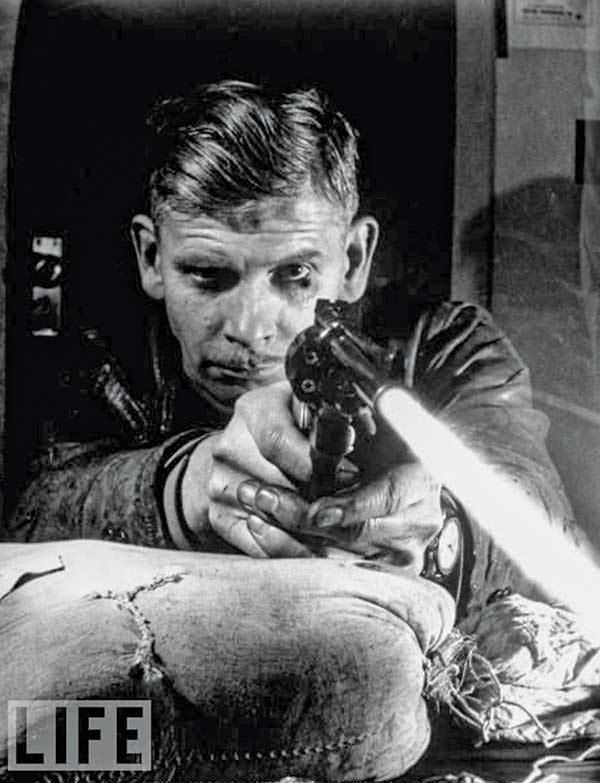
Developed in 1934 by Elmer Keith, Phillip B. Sharpe (pictured above), and Douglas B. Wesson, the .357 Magnum took the .38 Special, lengthen the case and “modernized” it with the use of smokeless powered, unlike the .38 Special which had started out life as a black powder cartridge. While not strictly necessary, upping the case length does prevent mixing the .38 Special and .357 Mag, a dangerous situation. Even using modern powders the .38 Special is limited in the pressures that it can have and still be called .38 Special.
While outdoorsmen liked the versatility of .357 Mag for use in both revolvers and lever guns, the police found that it was an excellent round for penetrating barriers such as car doors. Fresh out of the prohibition era, the police of this era were looking for just such a round and found that the .357 Magnum gave them what they were looking for until the 80’s when high capacity semi-auto pistols started to take over.
We could dive deeper, but much more on the .357 Magnum would be a whole other video, so the highlights. .357 Magnum was a popular police and outdoorsman round because of its versatility, penetration and performance. Only being eclipsed once high capacity semi-autos came to the market.
So it’s little wonder that someone would want to replicate the .357 Magnum for a semi-auto. It would take about a decade for this to happen from the start of the wonder nine era, but someone would do it.
The Birth of the .357 SIG
With a strong following that lasted over 50 years and continues to this day in certain circles, it was little wonder that the .357 Magnum would want to be replicated in a semi-auto format.
So, from 1934 we jump ahead to 1994. Wonder nines dominate, .40 S&W had recently appeared on the scene and tactical Tupperware was gaining ground. But revolvers were still kind of holding out as “hand cannons”, and for good reason.
Magnum Power & Semi-Auto Pistol Challenges
Now here’s the thing, most semi-auto cartridges are operating at lower pressures than your “magnum” revolver fair. For example, a 9mm at standard CIP pressures is pushing 35k PSI, a .357 Magnum is running around 44k.
While we could get into the weeds with pressure testing methods and other bits and bobs, the main point is that semi-autos are not as good at containing “magnum” loadings as their revolver counterparts. While this is not “exactly” the case today, it was a bit of a dividing line for quite some time and a lot of semi-auto’s were just not pushing to the limits of what could be done with a revolver. There’s a lot more that I could dive into here, but I don’t want to take up too much time with a massive discussion on cartridge pressures, revolvers vs. semi-autos, lock up strength of various designs, and more. Just understand that there is something to the lore of the “hand cannon” revolver. It’s just not exactly what people think it is.
So the main point is that revolvers have a bit of an advantage in their designs, able to contain more pressure and power because nothing has to “open” to eject a case after firing.
The Start of .357 SIG
But semi-autos had the advantage of capacity and the shooting world was moving on to higher capacity and semi-auto handguns were only getting more and more reliable and well made so in 1994 the market would see a new caliber, .357 SIG, looking to bring the hard hitting power of .357 Magnum to the world of high capacity pistols.
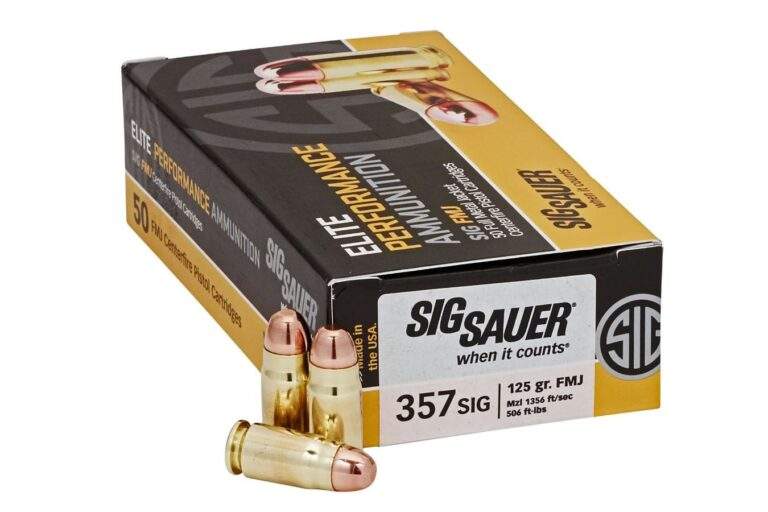
Firearms manufacturer SIG-Sauer and ammo producers Federal Ammunition teamed up to create a gun and ammo combo that would replicate the ballistics of the famed 125 grain .357 Magnum loadings for police and other law enforcement agencies.
Again, .40 S&W had hit the market a few years previously and the FBI was adopting the new round, so it was a good time to introduce not only a new caliber, as police agencies were open to change following the FBI’s lead, but SIG and Federal could pitch the new caliber as a high capacity stand in for a caliber that many experienced police chiefs and armorers at the time would be familiar with and trust, the .357 Mag, but in the high capacity, semi-auto format that many law enforcement agencies were moving to.
Now you would think that a cartridge developed in the early to mid 90’s would have better documentation than other, older cartridges, but most histories of the .357 SIG seem to leave the creation of the round as being the brainchild of SIG-Sauer and Federal Ammunition and don’t say much else on the topic, instead moving on to its rise and fall.
I dug a bit deeper and with the kind help of Daniel Watters was able to find a bit more from the dusty archives for you.
Dan, you’re a scholar and a gentleman and you dear viewer should be following him on X @556Timeline or reading his work on ScatteredShots.com
Making .357 SIG a Reality
Now the idea to replicate the .357 Magnum in a semi-auto format may have started out from complaints from the Texas Department of Public Safety. Now take this next bit with a grain of salt, as this seems to be a bit of hearsay but again this come from Daniel’s kind responses for my request to help me find info.

My understanding is this –
In 1991 the Texas DPS Troopers had recently moved from .357 Magnum Model 28’s and 586’s to the SIG P220 in .45 ACP in 1991. While they were using a custom 200 grain Speer “Flying Ashtray” load that would be replaced in 1993 by the 230 grain Ranger SXT loading. In addition to this the Texas DPS could have also opted for a 9mm loading of Winchester 127 grain OSM, then in 1993 a 127 grain Ranger SXT loading.
Yet it seems that the Troopers were not exactly happy with any of these loadings, wishing instead for something that would replicate the .357 Magnum 125 grain JHP loading that they had used since 1979.
It’s possible that these complaints trickled up to SIG and Federal, spurring the idea of the .357 SIG, but I don’t have any first-hand information on this.
Now on Federal’s side we had Michael Bussard and Alan Newcomb designing the round. Their round would utilize a 10mm case necked down to accept a .357 caliber bullet. Using a small pistol primer the necked down case would be a technical child of the 10mm auto, much like the .40 S&W.
In Dead Calibers Archives we have already covered the history of the 10mm Auto as well so once you’re done here, give that video a watch if you’re inclined.
Yet the concept of a bottle necked cartridge is far from new, there are many examples out there, from 9mm Dillion, 7.63 Mauser, 7.65 Borchard, 7.62 Tokarev, .256 Winchester Mag, .22 Remington Jet, and many others, along with a plethora of wildcats and one off experiments. The most interesting take I’ve seen is the .357-44, but that strange beast will have to be a topic for another video.
That said, the design of a bottle necked cartridge does give you some advantages, first it gives you more room for powder and hence a bigger bang. Many cartridges try to improve performance by taking a smaller bullet and necking down a case to that bullet giving the smaller diameter bullet more velocity.
But arguably the more important part in a handgun is the advantage in feeding.
Since the bottleneck creates a kind of ramp in the cartridge itself a bottlenecked case is, at least in theory, easier and more reliable in feeding than a straight walled cartridge. However this does present some challenges when it comes to reloading.
The introduction of the bottleneck gives a weak point to the cartridge at the shoulder, however. Especially when using a press if the annealing of the case is less than ideal. So the .357 SIG did not do itself any favors in the reloading world, but I suspect that given the law enforcement focus of the round, this was a distant secondary concern for SIG and Federal when designing the round.
Now, you may have noticed something, I said that the .357 SIG was using a .357 caliber bullet, but that’s not the case today. This was the original design for the caliber, not only would it replicate the performance of the .357 Magnum but use the same bullet caliber to do it and early specifications for the .357 SIG show it using a .357 caliber bullet.
Yet, this would soon change after the initial introduction of the cartridge. A slight change to a .355 or 9mm caliber bullet. I can only imagine that this was done for ease of production as 125 grain 9mm bullets would have been in higher volume production at the time and as best I can tell, produced little if any change to the performance of the round. So there’s a bit of conflicting data on the exact way the cartridge operates out there. But the final, and current design of the .357 SIG uses the case mouth for head spacing.
So, today you’ll find only data and barrels for the 9mm version of the .357 SIG, not the first draft, .357 caliber version.
The final result of Michael Bussard and Alan Newcomb’s work on the .357 SIG would be a bullet that would be 125 grains, at could sneak up to 1500 feet per second in a 5″ barrel and easily reach 500 foot pounds of force at the muzzle. Easily the equal of the .357 Magnum that it sought to replicate.
But what about SIG, the creators of the first guns to chamber the new round? Well on their side Daniel Watters suggested that it was most likely George Harris (pictured above) who brought the concept of a .357 Magnum power semi-auto cartridge to the attention of Ted Rowe, the president of SIG Arms at the time.
For their part SIG Would introduce the P229 in .357 SIG alongside the new round
.357 SIG's first Guns & Shooters
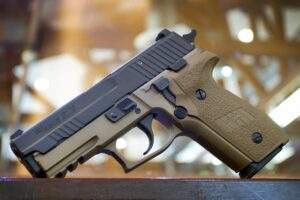
The P229 had already been on the market for two years and it was the first to get the .357 SIG as an option when the caliber was introduced. Of course the P229 is a compact version of the P226, both being duty style pistols, and the P226 would get a .357 SIG flavor soon after the P229.
Of course the P229 and P226 is a DA/SA affair in most versions, but you can find Double Action Kellerman or DAK models running around. This is a Double Action Only system that tries to make a smoother and lighter trigger pull for a DAO pistol.
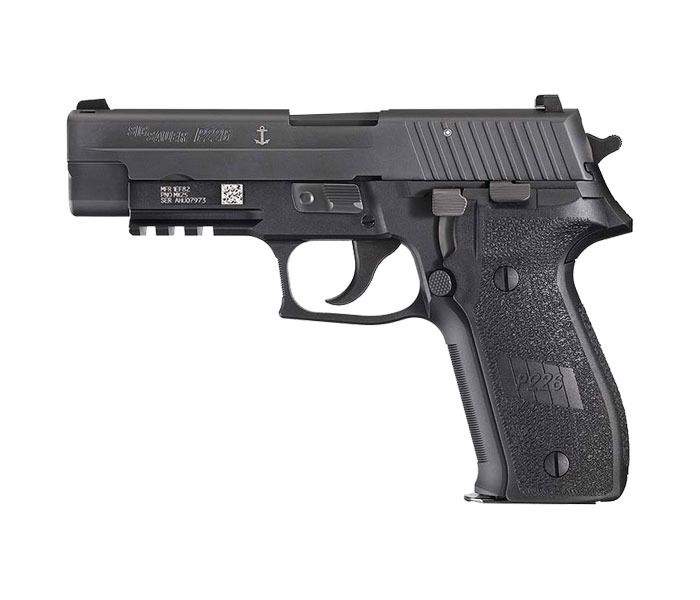
At least to me the P229 and P226 are “the” special forces pistol, with the Naval Special Warfare, read Navy SEALs, and US Secret service using them. Somewhere along the line, the media of my childhood got me convinced that this was the pistol for bad ass operators and I never have shaken the idea fully.
Of course you have the side mounted de-cocker and an almost unnecessarily high bore axis but if you asked younger me what gun our most elite forces run around with I probably would have guessed a P226.
The P226 for its part was also created to compete with the Beretta 92 to replace the 1911A1 in service. While the XM9 trials did leave both the 92 and the P226 standing, the lower cost of the 92 gave Beretta final victory in the competition.
However the P226 would be adopted by the Navy Seals, Secret Service, and many other law enforcement agencies. So it did still end up winning in the end, and it does remain a bright spot for SIG despite their current issues with their more recent designs.
However, SIG would not be the only ones to want to chamber the .357 SIG, Glock of course was very quick to adapt their offerings to the .357 SIG.
The G31, G32, and G33 would all roll out in rapid pace to eat SIG and Federal’s new caliber. Of course each of these were the standard Glock fair and almost the same as the .40 S&W offerings, just in the .357 SIG caliber.
And that brings me to the ease of conversion between the .357 SIG and the .40 S&W in pistols. For just about every .40 S&W pistol all that is needed to convert it over to shooting .357 SIG is a barrel swap and, depending on the specific pistol a heavier recoil spring.
Since both owe their linage to the 10mm, magazines are interchangeable and some magazines don’t bother making a distinction between the two calibers and many law enforcement agencies would adopt the .357 SIG over the FBI’s favored round.
It was the Delaware State Police that would be the first to adopt not only the SIG P229 but the .357 SIG alongside it as well in mid-1995, signaling the start of the adoption of the .357 SIG by various law enforcement agencies.
Others of note were the U.S Federal Air Marshals, the U.S. Secret Service, the Texas Rangers, Delaware State Police, Virginia State Police, Richmond Police Department, and the Rhode Island State Police. Oddly, the rumored instigators of this whole thing, the Texas Department of Public Safety would not adopt the .357 SIG until 1997.
Yet the love affair with the .357 SIG would not last and eventually it too would fall to the 9mm’s age of dominance.
.357 SIG Goes on Life support
Now I’ve already discussed some of the reasons why the .357 SIG didn’t exactly appeal to reloaders with the bottle necked design, but there’s more to the story than just a slightly more difficult reloading process that killed the .357 SIG.
First, despite being adopted by such a high profile agency as the Secret Service, it did not get the same traction with other law enforcement agencies that the .40 Smith & Wesson did. Then you have cost, .357 SIG is often the most expensive option when it comes to defensive handgun calibers of the “big five”. .380, 9mm, .40, .357 SIG, and .45. This is not always the case, but it is the general perception if nothing else.
Add to that the same capacity sacrifices that you make when moving to .40 S&W over 9mm, the continued pushing of 9mm bullet design and even hot 9mm +P loadings nipping at the heels of .357 SIG you start to understand why the cartridge has had a hard time catching on.
But there’s more to it. The .357 SIG also has a problem with recoil and service life.
First you do get some of the snappier recoil of the .40 S&W, not as severe as some would have you believe for either cartridge, but your average 9mm is going to be more controllable than you average .357 SIG.
Of course, LEO training being what it is, making an accurate shooter is easier if you are not fighting recoil to get back on target and it seems to be the mission of far too many LEO agencies to make officers, not good shooters.
Then you have the wear and tear on the guns themselves. .357 SIG does push the limits of what is acceptable in a handgun for service life. That extra velocity that it gets over 9mm does also produce more force on the guns internals as well and a .357 SIG pistol may not have the same service life as a pistol running 9mm. Going back to our C.I.P pressure standards, 9mm is running at 34,084 max PSI and .357 SIG 44,240 max PSI. Making the .357 SIG 130% of the pressure of a regular 9mm, that’s easily +P if not getting close to a 9mm proof load. Again, pressure testing methods, SAMMI vs. C.I.P standards, etc. is another ball of wax.
A strong consideration when you’re a private citizen on a budget or even a law enforcement agency that is not exactly rolling in cash.
But that said, .357 SIG does produce impressive results.
As an aside, when I was working on my Objective Handgun Round Effectiveness Formula, or OHREF Standard, I found that a few .357 SIG loadings did quite well, despite their capacity handicap.
Most defensive loadings on the market put up good penetration and expansion. Add to this a high velocity and flat shooting round at range, you do get something that you can start to understand why the Secret Service might want something that lets them reach out and touch someone better than a 9mm could.
Or well at least until 2019 when they dropped .357 SIG.
But I think we need to circle back around to a core issue with handguns to help explain why the .357 SIG has lost its luster with so many shooters.
Handguns kind of suck.
As modern pistol fighting has evolved from the early days to now, it has become apparent that no matter what you do with a handgun it is incredibly difficult to get a “one shot stop” outside of a hit to the central nervous system, and to be frank, 9mm does a good enough job at getting to those vital bits with more capacity and less recoil than other options.
Heck, even a rifle won’t guarantee putting someone down with a poorly placed shot unless it’s a .50 BMG.
So the market has, for better or worse, collapsed around the 9mm and ignored calibers like the .357 SIG because chasing that little bit of extra performance out of a handgun just does not seem to give as much of a benefit as we used to think.
Maybe down the line thoughts will change on this, but for the moment the .357 SIG remains left behind, a still capable caliber but dwarfed in sales and popularity by the de facto Germanic king, 9mm Parabellum.
I want to thank you all for watching and if you have enjoyed today’s video I do have other firearms history and development videos in the Dead Calibers Archive playlist for you to check out. It’s been a bit since I’ve been able to get a new video out, and as you can see by the new studio set up, I’ve moved and it took me a bit to get rolling again, so I do want to thank everyone for coming back.
This video was a suggestion by one of viewers Cheyenne Obregon184 and I want to thank them for the suggestion. If you’d like to see a specific caliber in the Archives let me know in the comment section on YouTube or Rumble